
By Lucas Morley, owner and heating engineer at Evo Flow Heating (Heat Geek partner, Gas Safe registered) · About Evo Flow Heating · Last updated 2026-06-05
Summary
A heat pump in a Gravesend semi will only run cheaper than your gas boiler if the install is designed properly, not slapped on. That means a room-by-room heat loss calculation, the right flow temperature for your radiators, modulating controls, and balanced commissioning before the installer leaves the drive. Get those four things right and the running cost beats the old gas boiler. Get any one of them wrong and the heat pump short-cycles, the COP drops, and the news articles about expensive heat pumps suddenly make sense. BUS grant takes 7,500 off the standard install in 2026, 9,000 if it is replacing oil.
From Lucas, the owner
When you compare three heat pump quotes for a Gravesend semi, do not look at the kit first. Look at the heat loss spreadsheet. If the installer cannot put one in front of you, room by room, with U-values for your walls and your actual radiator sizes plugged in, then you are not buying a designed system. You are buying a punt. The kit is the easy part, the maths is the job.
I had a call last month from a homeowner on one of the post-war semis off the A2 in Gravesend. She had two quotes already, both within a few hundred pounds of each other, both for a 7kW Daikin, both promising the BUS grant claim would be handled for her. She just wanted a third quote so she could be sure. When I asked her what the heat loss number was for her house, and what flow temperature each installer had designed the system to run at, neither quote had told her. They had quoted a heat pump that fits the wall, not a system that fits the house.
That is the conversation I want to walk you through here. Not the brochure version of a heat pump install in Gravesend. The actual version. What gets measured before the quote, what gets designed before the install, what gets balanced before we leave, and how to spot the difference between a heat pump that is going to halve your running cost and one that is going to disappoint you the first cold January.
Step one, before the quote: the heat loss calculation

Every properly designed heat pump install in Gravesend, or anywhere else for that matter, starts with a room-by-room heat loss calculation. That means I sit down with a tape measure, a floor plan, the U-values for your walls (assumed for a post-war semi, measured if it is unusual), and your glazing spec, and I work out how many watts of heat each room needs at the design outdoor temperature, which for Kent is around minus two degrees. That number is the headline. Everything else follows from it.
The headline matters because the heat pump has to be sized to it, not to the old gas boiler. A 30kW combi keeps a Gravesend semi warm because it bullies the system, it has so much output that the design margin papers over the missing maths. A 7kW heat pump cannot bully anything. It has to match the heat loss curve over a long, low, steady run. If the heat loss number for your house is 6.4kW and your installer is fitting an 8kW unit because that is what is on the van, the unit will short cycle on a mild Kent autumn day and the running cost will not be what you were promised.
I send the heat loss spreadsheet to every customer before the quote. Room by room. Total watts. The radiators in each room rated at the design flow temperature, not the gas boiler temperature. If you are getting heat pump quotes in Gravesend right now and none of them include this spreadsheet, ask for it. If they cannot produce one, you are not yet looking at a proper quote.
Thinking about a new system?
Talk to Lucas about a properly designed install
Free survey. Heat loss calculations before the quote, not afterwards. Written itemised quote with kit, labour and controls broken out. Gas Safe, MCS where the install is heat pump, and a Heat Geek-trained design head on every job.
Or call Lucas directly: 01474 612061
Step two, the design choice: flow temperature, controls, radiators
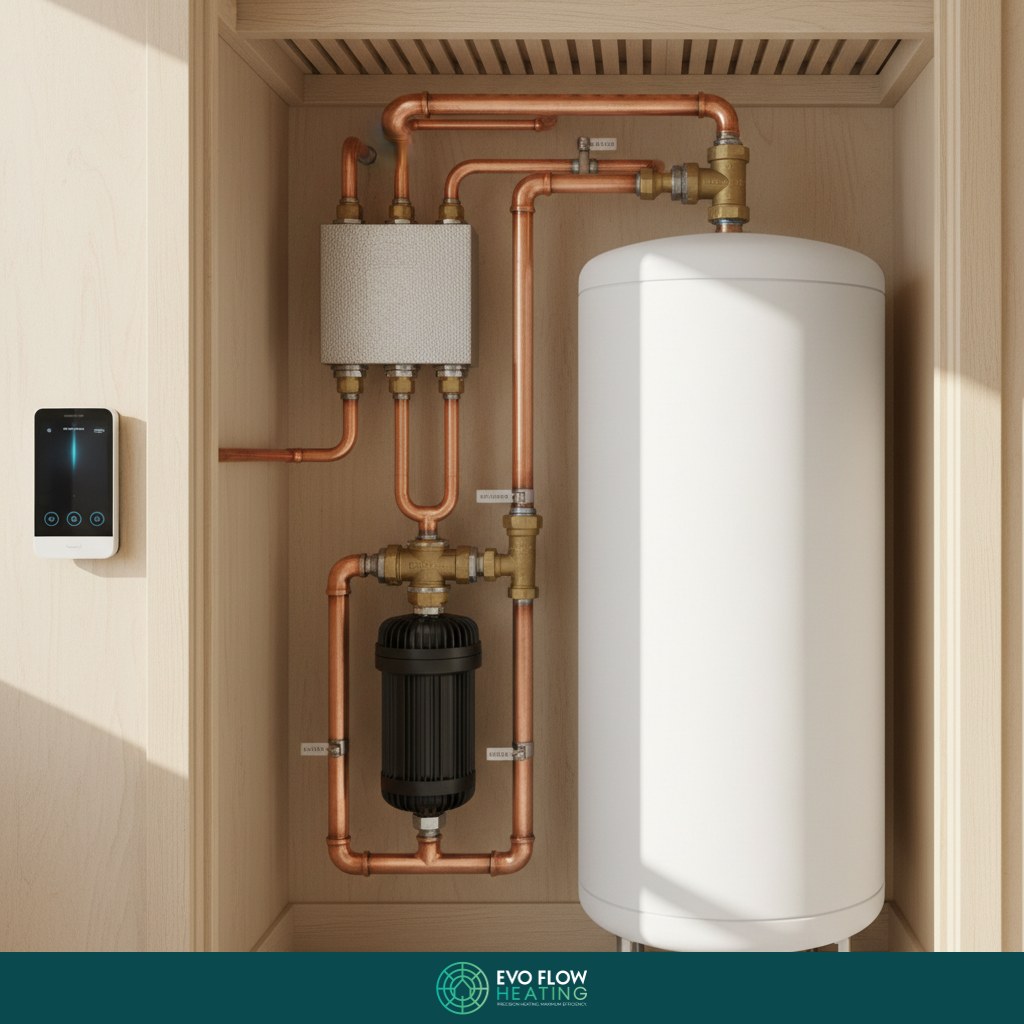
Once the heat loss is on paper, the system design is three intertwined choices: the flow temperature the heat pump will run at, the controls that decide when it runs, and whether the existing radiators are big enough at that flow temperature. These three choices decide your coefficient of performance, the COP, which is how many units of heat you get out for every unit of electricity you put in. A heat pump running at 35 degrees flow temperature into properly sized radiators in a Gravesend semi will hit a COP between three and four. The same heat pump running at 55 degrees because the installer did not upsize a couple of bedroom radiators will hit somewhere between two and two and a half, and your bills will reflect the difference.
Modulating weather compensation controls are not an optional upgrade. They are the controls that tell the heat pump to ease off when the outside temperature climbs, and to push a bit harder when it drops. A dumb on-off thermostat will turn the heat pump on at full pelt, the room will overshoot, the heat pump will short cycle, and your COP will collapse. Modulating controls as standard, not as an upgrade, is one of the differences between a Heat Geek-trained install and a cheap-and-cheerful job. The boiler-style installers who have not done the heat pump training tend to skip this bit, then blame the technology when the customer complains.
On radiators, the rule of thumb for a Gravesend post-war semi is that about half the rooms will be fine, and one or two will need a bigger panel. That sounds like a problem until you see it on the quote: a few hundred pounds for a couple of swaps, and you keep the lower flow temperature, and the running cost difference pays the radiator swap back inside the first year. Always ask the installer which rooms are going to need a radiator change and what the new sizes are. If the answer is ‘no changes needed’ for every room in a 1950s semi, that is a flag, not a feature.
Step three, the BUS grant and what it actually covers in 2026
The Boiler Upgrade Scheme grant in 2026 is 7,500 pounds against an air source heat pump install where you are replacing a gas boiler or a non-condensing alternative, and 9,000 pounds where you are replacing an oil boiler. We claim it on your behalf. There is no paperwork for you to chase, no form for you to fill in, and the grant comes off the quoted price, not as a rebate you wait six months for. That is the rule for an MCS-certified installer, which we are.
On a typical Gravesend post-war semi, a properly designed 6kW to 8kW heat pump install in 2026 retails somewhere in the 10,000 to 14,000 pound range depending on the cylinder size, the controls, the radiator changes, and whether the existing pipework can be reused. Take the BUS grant off and the customer’s out-of-pocket number lands somewhere between 3,000 and 7,000 pounds. If your quote is significantly above that range for a normal semi, ask what is in the kit list that makes it sit there. Sometimes the answer is good (oversized cylinder for a future bathroom, three-phase upgrade, hard-to-route pipework). Sometimes the answer is a margin that has not been justified.
If you are coming off oil and your house is anywhere on the rural side of Kent, the 9,000 pound grant changes the maths completely. A typical detached Sevenoaks or Pembury property switching from oil tends to end up with an out-of-pocket figure not too dissimilar to a new oil boiler, and a long-term running cost that beats the oil. We will run the comparison either way before you commit.
“New boiler installation. Lucas was very professional and obviously takes great pride in his work. He is friendly to deal with. He tidied up everything and even improved the installation by modifying the existing condensate pipework, so that most of it now runs inside the loft.”
Andy P. · Homeowner, Kent, new boiler installation (Google review)
Step four, the install week and the commissioning we do before we leave

A typical Gravesend semi heat pump install runs three to four days on site. Day one is the outdoor unit on its plinth, the refrigerant pipework run through the wall, and the isolator wired in. Day two is the indoor side: cylinder swap, low-loss header where the existing pipework requires it, magnetic filter on the return, and the new controls. Day three is the radiator swaps where the heat loss called for them, and the system balance. Day four is commissioning: flow temperatures dialled in, weather compensation curve set against the Kent design temperature, MCS sign-off documentation, and the handover walkthrough.
The commissioning is the part most cut-corner installs skip, and it is the part that decides whether your COP is three or two. We run the system across its expected flow temperature range, we set the lockshield valves on every radiator so each room reaches its design temperature at the same time, we run the weather compensation curve against actual outdoor readings, and we leave you with the controller set up so you can see what your system is doing in real time. The handover takes about an hour. You will know more about your heating system at the end of it than most people do.
Heat Geek’s zero-disrupt methodology is the part of our training that decides how much of your existing pipework we reuse. The short version: if the existing pipework can carry the heat pump’s design flow rate at the design flow temperature, we keep it. If it cannot, we upsize the bits that fail the calculation, not all of it. That keeps your install tidy, your bill lower, and your house liveable for the install week.
- Ask for the heat loss spreadsheet before you accept any heat pump quote. Room by room, with U-values and design flow temperature noted. If it does not exist, the quote does not exist either.
- Ask which radiators are being changed. A Gravesend post-war semi almost always needs one or two upsized. “No changes” is a flag.
- Ask what flow temperature the system is designed at. 35 to 45 degrees is the right band for an efficient install. 55 is the gas boiler temperature, used as a shortcut.
- Ask whether the controls are modulating weather compensation, not just an on-off thermostat. This is non-negotiable for a good COP.
- Ask whether the installer is MCS-certified and whether they claim the BUS grant on your behalf. We are, and we do.
- Ask for a Heat Geek-trained installer if the design-first methodology matters to you. We are listed.
- Compare three quotes line for line: kit, labour, controls, radiator changes, commissioning. If one quote buries the controls in the kit price and another breaks them out, the headline numbers are not comparable.
Related heating services and areas
Our services
Areas we cover
Evo Flow Heating
Designed properly, not slapped on
Lucas designs the system and Lucas runs the install. Heat loss calc, flow rates, modulating controls and balanced commissioning on every job. Gas Safe registered, MCS-certified for heat pumps, and BUS grant claim handled for you. Itemised written quote with kit, labour, controls and VAT broken out, so three quotes can be compared like for like.
Or call Lucas on 01474 612061 · office 01474 612061
Frequently asked questions
How much does a heat pump installation cost in Gravesend in 2026?
For a properly designed 6kW to 8kW air source heat pump on a typical Gravesend post-war semi, expect 10,000 to 14,000 pounds retail, before the BUS grant. The BUS grant takes 7,500 pounds off (9,000 if you are replacing oil). Out of pocket lands somewhere between 3,000 and 7,000 pounds for most jobs, depending on cylinder size, controls and radiator changes.
Will a heat pump actually run cheaper than my gas boiler?
It will if the install is designed properly. Properly means a heat loss calculation, a low design flow temperature (35 to 45 degrees), modulating weather compensation controls, and balanced commissioning. Get those four things and your COP sits between 3 and 4 and the running cost beats the gas boiler. Get any one of them wrong and the heat pump short cycles and the saving disappears.
How long does a heat pump install take on a Gravesend semi?
Three to four days on site for a typical post-war semi: outdoor unit and pipework, then indoor cylinder and controls, then any radiator swaps the heat loss calls for, then commissioning. The house is liveable throughout. The heating switches over on the last day.
Is my Gravesend house actually suitable for a heat pump?
Most post-war and 1930s semis around Gravesend are. The deciding factor is whether the existing radiators can be sized for a 35 to 45 degree flow temperature in each room, and whether there is somewhere outside to mount the unit cleanly. We work that out on the survey visit, with the heat loss spreadsheet, before you commit to anything.
Do you handle the BUS grant claim for me?
Yes. We are MCS-certified and we claim the BUS grant on your behalf. The grant value comes off the quoted price, not as a rebate. No customer paperwork.
Why does the news keep reporting on heat pumps that disappoint?
Because most of those installs were sized to the old boiler, not to a heat loss calculation, ran on dumb thermostats instead of modulating weather compensation, and were not balanced before the installer left. The technology is fine. The design is what most installers skipped. That is the difference between a Heat Geek-trained install and a cheap-and-cheerful job.
For more Kent heating advice, browse the Evo Flow Heating blog or call Lucas on 01474 612061.