
By Lucas Morley, owner and heating engineer at Evo Flow Heating (Heat Geek partner, Gas Safe registered) · About Evo Flow Heating · Last updated 2026-05-19
Summary
A boiler that keeps losing pressure is almost always one of four things: a small leak somewhere on the heating circuit, a failing expansion vessel, a passing pressure relief valve, or a leaking auto air vent. The trick to fixing it permanently is finding the right one, not topping the system up and hoping. Most Kent homeowners get into a pattern of refilling the boiler every week, which masks the real fault and slowly damages the boiler. Here is how a heating engineer works through the four possibilities on a survey visit, with a Maidstone semi case study to make the diagnosis concrete.
From Lucas, the owner
If your boiler pressure drops noticeably ONLY when the heating is on, the fault is almost certainly inside the boiler, usually the expansion vessel or the PRV. If it drops slowly over days regardless of whether the heating is firing, the fault is almost certainly a small leak somewhere on the radiator circuit. That single distinction narrows the diagnosis from four possibilities to two before I even open my toolbox.
I got a call last spring from a homeowner in one of the 1930s semis near the river in Maidstone. Her boiler pressure had been dropping from 1.5 bar to 0.5 bar roughly every five days for nearly a year. Every five days she would top the system up at the filling loop, the boiler would fire happily for a week, then the low pressure alarm would come on again. Her previous installer had told her on the phone it was probably just an air bleed somewhere and not to worry. After a year of topping up every five days, she had finally had enough.
When I went out for the survey, I had a hunch what it was before I opened the case. The pattern (slow loss regardless of whether the heating was on) told me it was almost certainly a small leak on the radiator circuit, not an internal boiler fault. Twenty minutes with a pressure gauge and a torch later I had found it: a slow weep on a compression joint on the upstairs landing rad, hidden under a carpet flap. Half an hour to fix. No more topping up. What I want to walk you through here is the same diagnostic ladder I used that morning, so when your boiler keeps losing pressure you know what an honest answer looks like.
Cause one: a slow leak on the heating circuit
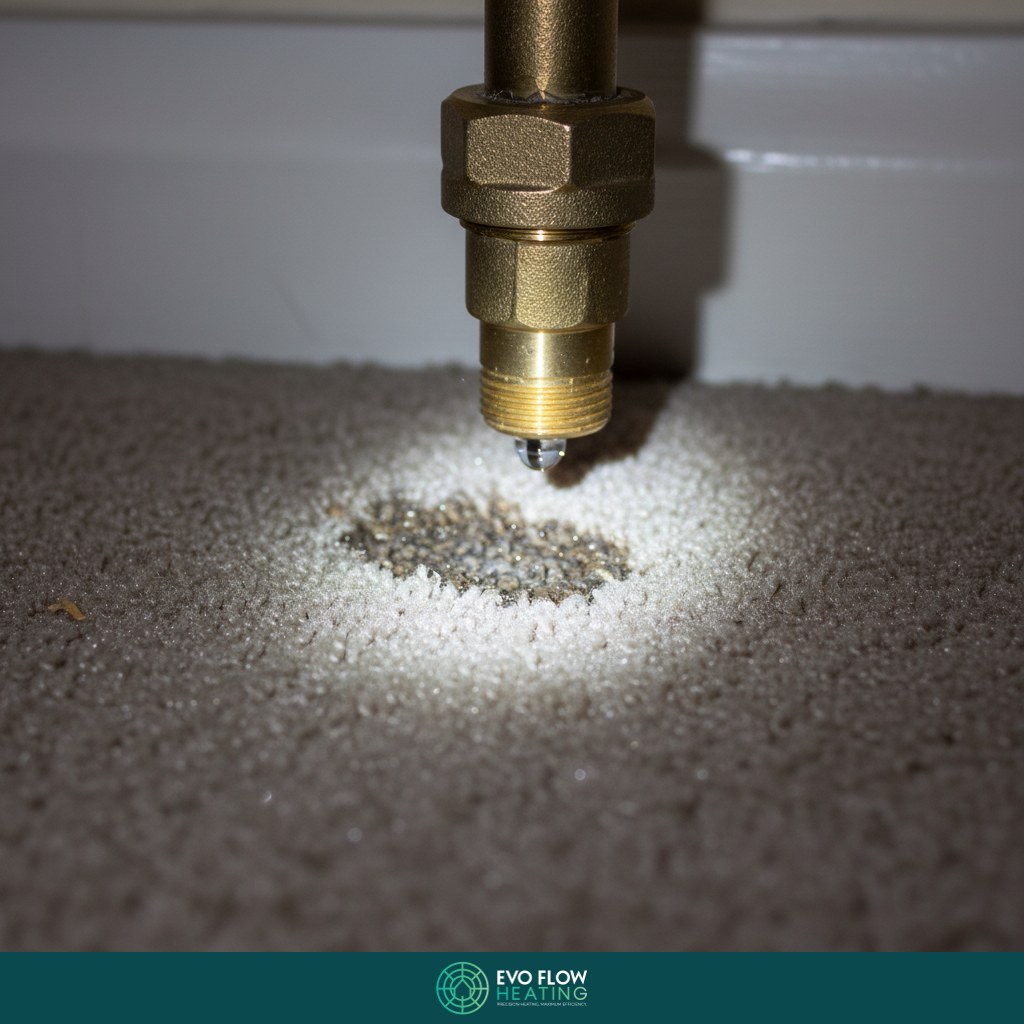
Roughly seven out of ten boilers that keep losing pressure in a Kent home are leaking somewhere on the radiator circuit, not inside the boiler itself. The leak is usually small. A weep on a compression joint, a slow drip at a radiator valve gland, a stress fracture on a microbore pipe where it goes through a floorboard, a rotten lead-and-oakum joint on an old wrought iron rad. None of these will flood your house. All of them will lose you 0.5 bar every few days, which is exactly the pattern most homeowners describe on the phone.
The way I look for one is methodical. Pressure gauge on the boiler, then a torch and a slow walk round every radiator valve, every joint visible, every floorboard you can lift, every airing cupboard and every utility cupboard. The leaks are almost always hidden, because if they were obvious you would have seen them yourself. The Maidstone semi case was textbook: a slow weep on a compression joint on the landing, hidden by a carpet flap. Tightened the joint, applied a fresh dab of jointing compound, refilled, problem gone.
If the leak is on a buried microbore pipe under a screeded floor, the cure is more involved. Sometimes it is a localised dig-up, sometimes it is a rerun in plastic pipe between radiator and manifold. Either way, the diagnosis is the same: a thermal imaging pass over the floor on a heating cycle usually finds the wet patch within ten minutes. If the worst comes to worst and the system is on its third or fourth slow leak, that is a conversation about a system redesign rather than another patch.
Thinking about a new system?
Talk to Lucas about a properly designed install
Free survey. Heat loss calculations before the quote, not afterwards. Written itemised quote with kit, labour and controls broken out. Gas Safe, MCS where the install is heat pump, and a Heat Geek-trained design head on every job.
Or call Lucas directly: 01474 612061
Cause two: a failed expansion vessel inside the boiler
Every sealed-system boiler has an expansion vessel, a small steel tank with a rubber diaphragm and an air charge on one side and water on the other. As the system heats up, the water expands and pushes into the vessel against the air. As the system cools, the water draws back out and the air re-expands. That is what keeps the pressure roughly steady through a heating cycle.
When the diaphragm fails or the air charge leaks out, the pressure on a cold system reads normal but spikes hard when the heating fires, the pressure relief valve opens to dump the excess water out through the overflow pipe outside, and an hour later the pressure on the gauge has dropped below 1 bar. The classic tell is pressure that drops only when the heating is running and stays steady when it is off. Stick a finger on the schrader valve on the side of the expansion vessel, if water comes out instead of air, the diaphragm has gone.
The cure is usually re-charging the air side with a foot pump if the diaphragm is intact, or replacing the vessel if it is not. On most modern combis the vessel is inside the case and the job is half a day with the case off. On some installs there is a secondary external expansion vessel near the boiler, which is even easier to swap. Either way, this is a standard part of the toolkit on a survey visit, not a major job.
Cause three: a passing pressure relief valve (PRV)

The PRV is the safety valve that opens if the pressure goes over about 3 bar. It is plumbed to an overflow pipe that exits the wall outside. When the valve is working properly, it stays shut for years and only opens if something is properly wrong (usually a failed expansion vessel from cause two). When the valve fails it stops sealing properly even at normal operating pressure, and the system slowly loses water out through the overflow pipe.
The diagnostic test for a passing PRV is the easiest one on the list. Go outside, find the overflow pipe (usually a 15mm pipe poking out of the wall near the boiler), and check whether it is dripping. If it is, the PRV is either passing or the expansion vessel has failed and the PRV is doing its job correctly under the pressure spike. A pressure gauge on the boiler will tell you which: if the cold-system pressure climbs to 3 bar when the heating fires, the expansion vessel is the root cause and the PRV is just relieving. If the cold-system pressure never goes above 2 bar but the PRV is still dripping, the valve itself has failed and needs replacing.
Replacing a PRV is a parts job, 15 to 25 pounds for the valve and an hour for the labour, but you only do it if the expansion vessel is healthy. Replace the PRV without fixing a failed expansion vessel and you have just swapped the leak point. This is where the diagnostic order matters.
“We had an issue with the pressure gauge on our boiler. Lucas fitted us in that week, arrived promptly and fixed the issue in good time. He was friendly, thorough, explained everything clearly and answered any questions we had.”
Emmie T. · Homeowner, Kent, boiler pressure gauge repair (Google review)
Cause four: a leaking auto air vent (AAV)
The AAV is a small brass-bodied valve, usually at the highest point of the heating circuit or on top of the boiler itself, that vents air automatically when the system is filling or when air has worked its way into the circuit. When it fails it leaks water instead of just venting air, and the leak is usually slow enough that the homeowner does not notice it for months.
The diagnostic is a careful inspection of the AAV body for water staining or a slow drip. The cure is a five-minute swap with a new AAV (under 15 pounds for the part) and a top-up of the system afterwards. This is the least common of the four causes but probably the easiest fix. On the Maidstone semi case it was not the AAV, but I check it every time as part of the survey because it takes a minute and the part is under fifteen pounds.
If you are reading this and you have already topped up the boiler more than two or three times in the last few weeks, please stop and book a survey rather than continuing to refill. Each top-up dilutes the corrosion inhibitor in the system, and over time that lets the radiators sludge up and the heat transfer drop. Topping up is not the fix, it is what hides the fix. A Maidstone heating engineer survey will find the actual cause inside two hours.
- Note the pattern. Does the pressure drop only when the heating is running, or all the time? That single fact narrows the diagnosis from four causes to two.
- Check the overflow pipe outside the wall. A drip there is either a passing PRV or a failed expansion vessel. No drip rules both out.
- Look for damp patches near every radiator valve, every visible pipe joint, every airing cupboard. A torch and ten minutes finds most slow leaks.
- Stop topping the boiler up. Each top-up dilutes the corrosion inhibitor and hides the real fault. Two top-ups in a month is the point to ring a heating engineer.
- Do not bleed every radiator “just in case”. If air is genuinely working its way into the system, that means something is drawing it in, which is a fault, not a maintenance task.
- If the system was last flushed years ago, ask whether the diagnosis visit can include a system inspection: sludge in the radiators can mask other faults and a clean system runs cooler, longer.
- Ask for the corrosion inhibitor to be dosed after any fix. A fresh inhibitor charge after a top-down repair is the difference between a fix that lasts five years and one that lasts five months.
Related heating services and areas
Our services
Areas we cover
Evo Flow Heating
Designed properly, not slapped on
Lucas designs the system and Lucas runs the install. Heat loss calc, flow rates, modulating controls and balanced commissioning on every job. Gas Safe registered, MCS-certified for heat pumps, and BUS grant claim handled for you. Itemised written quote with kit, labour, controls and VAT broken out, so three quotes can be compared like for like.
Or call Lucas on 01474 612061 · office 01474 612061
Frequently asked questions
Why does my boiler keep losing pressure even though I cannot see any leaks?
Because the leaks are almost always small and hidden: a slow weep at a radiator valve, a stress fracture on a microbore pipe under a floorboard, or a slow drip on the overflow pipe outside the wall. A heating engineer with a pressure gauge and a torch will find it in a survey visit. Most homeowners look on the visible pipework and see nothing, which is normal.
Is it bad to keep topping up my boiler pressure?
Yes, after the first couple of top-ups. Each refill dilutes the corrosion inhibitor in the system, which is what stops the radiators sludging up over time. More importantly, topping up hides whatever the underlying fault is. Two top-ups in a month is the point to book a survey rather than continuing to refill.
How much does it cost to fix a boiler that keeps losing pressure?
A leaking compression joint on a visible radiator pipe is usually a 30 minute fix, somewhere in the 80 to 150 pounds range. A failed expansion vessel re-charge or replacement is 120 to 250. A passing PRV is 80 to 150. A leaking AAV is 60 to 100. The diagnostic survey itself, if booked alone, is a flat fee that we deduct from the repair if you go ahead.
My boiler pressure only drops when the heating is on. What does that mean?
That pattern points to an internal boiler fault, almost always either a failed expansion vessel or a passing pressure relief valve. The diagnostic test for each is straightforward, and the fix is usually under 250 pounds.
Could it be air in the radiators causing the pressure loss?
Not directly. Bleeding air out of a radiator drops the pressure once, but a system that is sealed and healthy does not draw new air in. If your radiators keep needing bleeding, you have a fault that is sucking air in (often through the same point that is losing pressure), and the cure is to find and fix the fault, not to keep bleeding.
Do you cover Maidstone and the wider Kent area?
Yes, Maidstone, Gravesend, Dartford, Tonbridge, Sevenoaks and most of Kent. Call 01474 612061 for a survey booking, or use the contact form for a callback. Survey visit usually within a week.
For more Kent heating advice, browse the Evo Flow Heating blog or call Lucas on 01474 612061.